
What Is This Condition and How Does It Affect Your Vision?
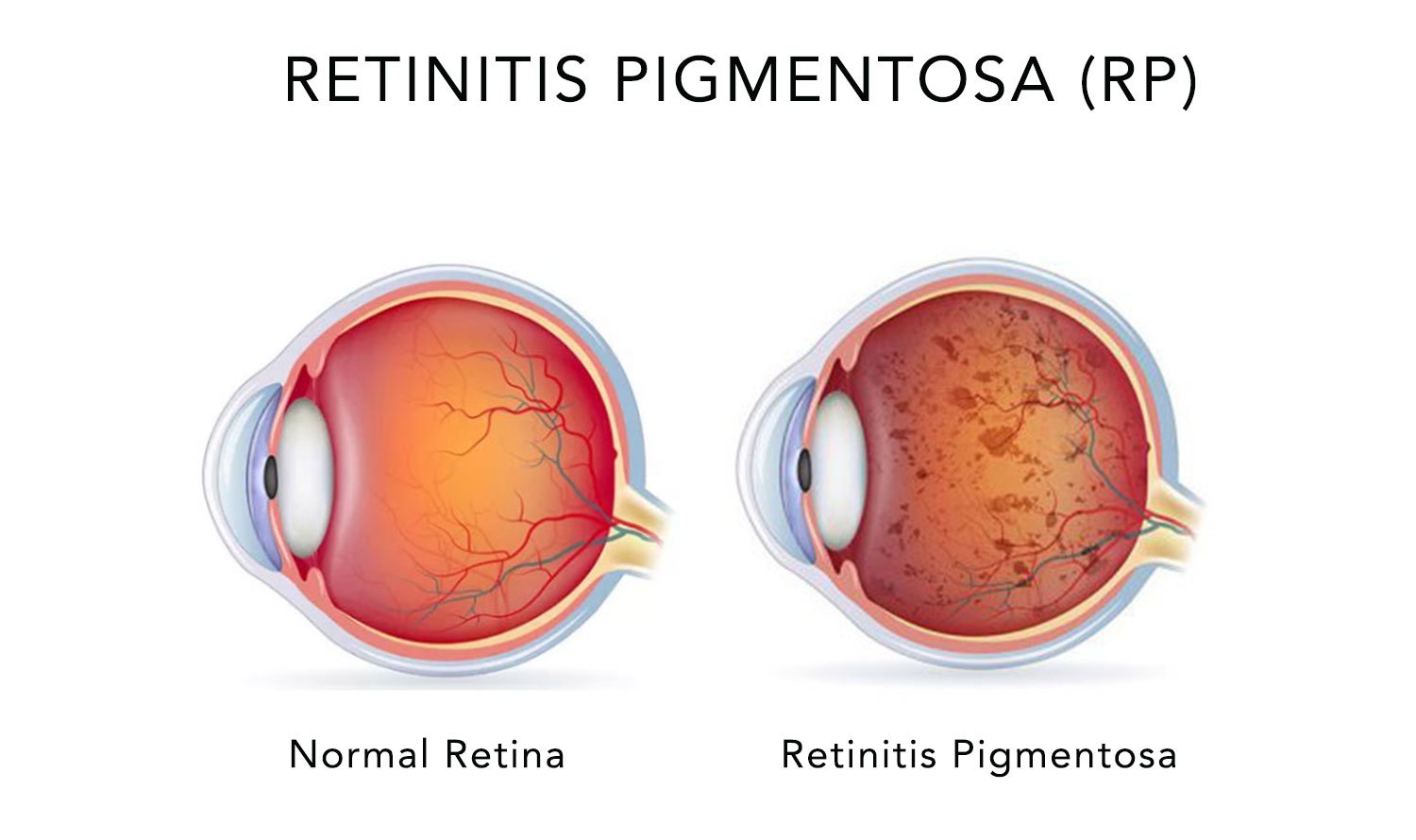
So what is retinitis pigmentosa actually doing to your eyes? Here is the short version. RP refers to a group of inherited retinal diseases, hereditary disorders where the photoreceptors, the tiny cells in your retina that detect light, slowly break down and die. Think of your retina like the sensor in a digital camera. It sits at the back of the eye, catches light, and converts it into electrical signals your brain turns into the images you see.
The photoreceptors are the cells doing that work. There are two types. Rods handle low light and side vision. Cone cells handle color and sharp central vision.
With retinitis pigmentosa the rods are usually first to go. Night blindness creeps in before anything else. You notice it at restaurants where the lighting is low. Driving home after sunset starts feeling sketchy. You walk into a dark movie theater and for a few seconds you literally cannot see anything and you are just standing there hoping you do not trip. Then the edges of your vision start pulling inward. Slowly. Like somebody is closing curtains from both sides. People call it tunnel vision and that is exactly what it feels like. The center might stay sharp for years, sometimes decades. But the world around that center keeps shrinking and you feel it every single day.
RP is genetic. It can be inherited in different patterns. The genetics get complicated fast. Autosomal dominant means you only need the mutation from one parent. Autosomal recessive means both parents have to pass it on. X-linked hits mostly males. And then there is Usher syndrome, where RP patients lose both vision and hearing, which is its own special kind of devastating. Genetic testing tells you which mutation you carry, and honestly that matters because some mutations move fast and others take decades to do real damage. As far as conventional treatment goes? There is one approved gene therapy and it only works for one specific mutation called RPE65. Everybody else gets vitamin A supplements and a follow-up appointment. That is basically it. The Foundation Fighting Blindness, the National Retinitis Pigmentosa Association, and other research groups are pouring money into emerging drug therapies and clinical trials, but realistically most of that is still years out.
This is why so many RP patients look for complementary approaches. Not because they have given up on conventional medicine. Because conventional medicine just has not gotten there yet.
Acupuncture for RP and Inherited Vision Loss in Vancouver
The doctor said it casually. Almost too casually. Retinitis pigmentosa. You typed it into your phone right there in the parking lot because you had never heard those two words in your life. Then you went home and searched it and your stomach dropped. A group of related eye disorders that cause progressive vision loss. No cure. Limited treatments. And the vision you lose? Gone for good.
If that is where you are right now, or if you have been living with retinitis pigmentosa for years and watching things slowly close in, we want you to know something. There is more that can be done than what most people are told. Not a miracle. Not a cure. But real, measurable support that can slow the decline and protect what you still have.
Retinitis pigmentosa is personal to us at Honor Wellness. It is one of the conditions we see the most through our vision program in Vancouver. Our practitioner Andrew Lin learned the method directly from Dr. Andy Rosenfarb, a pioneering doctor who ran the retinitis pigmentosa study with Johns Hopkins and the NIH that put acupuncture for RP into peer reviewed journals. That mentorship is the backbone of how we treat RP patients in our clinic today.
Why Genetic Testing Only Tells Part of the Story
Here is the part most people miss about retinitis pigmentosa. Yes, RP starts with a gene mutation. Nobody argues that. But how fast you lose vision? That is not all genetic. Not even close. When blood flow to the retina slows down, those photoreceptors stop getting the oxygen and fuel they need. They get weaker, faster. The support layer underneath them, the retinal pigment epithelium, starts falling behind on its job of feeding and cleaning up after those cells. Junk accumulates. Inflammation parks itself in the retinal tissue like an uninvited guest who will not leave. And oxidative stress, which is basically your body failing to take out the trash fast enough, speeds the whole breakdown up. None of that is genetic. That is circulation. Inflammation. Metabolism. And all of it can be worked on.
Why does this matter? Because it means how fast retinal degeneration moves is not set in stone by your DNA. There are levers you can actually pull. If the stuff accelerating the damage gets managed, you buy time. You keep those remaining photoreceptors alive longer. And that is exactly what acupuncture for retinitis pigmentosa goes after. The non-genetic factors. The ones nobody else is treating.
How Acupuncture Helps RP Patients
No needles go in the eyes. The points are along the eyebrows, temples, and the bone around the eye socket. Additional points on the arms and legs work through the nervous system to increase blood flow to the retina, reduce inflammation, and support the health of the photoreceptors and the support layer beneath them.
In our clinic, RP patients report improvements in night vision, wider peripheral awareness, sharper contrast, and greater stability. We track every case using visual field tests and acuity measurements so progress is documented with data, not just how someone feels.
Clinical Results and What the Research Shows
The clinical research backs this up. A pilot study at Johns Hopkins University found that half of the RP patients treated with acupuncture had meaningful improvements in function. Three of nine patients showed a 13 to 53 fold improvement in light sensitivity, and those gains held for 10 to 12 months after treatment ended. That study was funded by the NIH.
A separate study comparing acupuncture to a sham control group found acupuncture produced a 34 percent greater increase in blood flow to the macular area compared to the control. The study measured actual blood flow changes with imaging, not self reporting.
Then in 2025 a review in International Ophthalmology pulled all of this together and confirmed that acupuncture helps RP through three main pathways: slowing down photoreceptor cell death, boosting blood flow to the retina, and supporting the processing areas of the brain that handle vision. This is not someone’s blog post. These are published findings from real journals.
Every RP patient who walks into Honor Wellness gets a full assessment. Your diagnosis, your stage, your visual field results, what therapies and treatments you have tried, how fast things have been changing. We build your plan around your specific situation because RP does not move at the same speed for everyone and the approach has to reflect that.
We also coordinate with your ophthalmologist and any other providers involved in your care. Acupuncture works alongside whatever else you are doing. It is not a replacement. It is what fills the gap that conventional therapy has not been able to close.
RP is a disability that nobody prepares you for. The adjustment is brutal. When you lose your night vision you stop saying yes to dinners out. You make excuses. When your peripheral vision goes, crossing a busy street becomes genuinely scary. You bump into things you used to see. You misjudge doorways. And the heaviest part, the part nobody talks about, is the grief of watching your world physically get smaller year after year while the people around you have no idea what that actually feels like.
We get it. And we take that seriously. At Honor Wellness your RP care is not just needles and measurements. It is a team that understands what you are going through and fights alongside you to protect every bit of vision that is still there.
If you have retinitis pigmentosa and you have been told there is nothing more that can be done, that is not the full story. There is more. And it starts with a conversation.
Retinitis pigmentosa does not care about your plans. Retinitis pigmentosa does not check with you before taking another slice of your peripheral vision. But retinitis pigmentosa can be slowed. Retinitis pigmentosa can be managed. And retinitis pigmentosa patients who take action early give themselves the best possible shot at holding on to what matters most.
People who just got the retinitis pigmentosa diagnosis last month and are still processing what it means. People who have had retinitis pigmentosa for twenty years and feel like the tunnel gets tighter every season. Retinitis pigmentosa patients dealing with Usher syndrome on top of everything else. Young adults with retinitis pigmentosa who cannot stop thinking about what they will or will not be able to see at 40. Every single retinitis pigmentosa case is its own story. But the goal never changes. Protect what is still working. Fight for every last degree of field. Retinitis pigmentosa does not get to write the ending.
Book a consultation and find out what acupuncture can do for vision.
Frequently Asked Questions
Can stress accelerate the progression of retinitis pigmentosa?
Stress can accelerate the progression of retinitis pigmentosa by triggering oxidative stress and systemic inflammation that further compromise the health and survival of photoreceptor cells in the retina. Chronic stress also elevates cortisol levels which can negatively impact circulation to the delicate structures of the eye. While stress alone does not cause retinitis pigmentosa, managing it effectively is an important part of protecting remaining vision. Acupuncture is particularly valuable in this regard as it calms the nervous system, reduces stress hormones, and improves blood flow to the retina to support long term visual health.
Is it safe for someone with retinitis pigmentosa to continue driving?
Whether it is safe for someone with retinitis pigmentosa to continue driving depends entirely on the stage of the condition and the degree of visual field loss at the time of assessment. In the early stages when central vision remains relatively intact some patients are still able to drive safely under specific conditions. As peripheral vision continues to narrow and night vision deteriorates, driving becomes increasingly dangerous and is eventually no longer safe or legally permitted. Regular vision assessments with a qualified eye care professional are essential to making informed and responsible decisions about driving with retinitis pigmentosa.
What factors are known to worsen the progression of retinitis pigmentosa?
Several factors are known to worsen the progression of retinitis pigmentosa and accelerate the degeneration of photoreceptor cells in the retina. Prolonged exposure to bright sunlight without UV protective eyewear, smoking, nutritional deficiencies particularly in vitamin A and omega 3 fatty acids, chronic oxidative stress, and poor circulation to the retina are all significant contributing factors. Certain medications have also been associated with accelerating retinal degeneration in genetically susceptible individuals. Supporting retinal health through targeted nutrition, UV protection, stress management, and regular acupuncture treatments that improve ocular circulation can all play a meaningful role in slowing progression.
What does the visual experience of someone with retinitis pigmentosa typically look like?
The visual experience of someone with retinitis pigmentosa is often described as looking through a narrow tunnel, as peripheral vision gradually narrows and closes in over time while central vision remains relatively preserved in the earlier stages of the condition. Night blindness is typically one of the first and most noticeable symptoms, making it difficult to see in low light environments or when transitioning from bright to dark settings. Colors may appear less vivid, contrast sensitivity is often reduced, and bright lights can cause significant glare and discomfort. The rate at which vision changes varies between individuals, but the progression is generally gradual and spans many years.