
Diabetic Eye Disease and Vision Loss from Diabetes
You sit in the dim exam room while your eye doctor pulls up the scan. They start pointing things out, tiny dots, a dark patch, a blot that should not be there. Blood vessels that have started leaking. Others that look like they are shutting down entirely. And then they say the words: diabetic retinopathy.
Nobody really prepares you for that moment. You probably knew, somewhere in the back of your mind, that diabetes could affect your eyes. But knowing it as a fact and seeing the actual damage on a retinal scan are two completely different experiences. One is abstract. The other hits you in the chest.
So what is diabetic retinopathy, exactly? It is a progressive eye disease that weakens the blood vessels inside the retina, and here is what scares people, it does not need your glucose to be wildly out of control before it starts doing damage. Diabetic retinopathy can show up during stretches where your numbers look perfectly reasonable. It builds quietly. You will not feel it. You will not see it coming. That is partly what makes diabetic retinopathy so dangerous.
At Honor Wellness in Vancouver, we work with patients who have been diagnosed with diabetic retinopathy and want more than just monitoring. Our vision program uses ophthalmic acupuncture alongside whatever care you are already getting from your ophthalmologist and diabetes team. I want to be upfront about something: acupuncture is not here to replace your injections, your laser treatment, or your medications. What it does, and this is the piece most people are missing, is go after the underlying factors those treatments were never built to address.
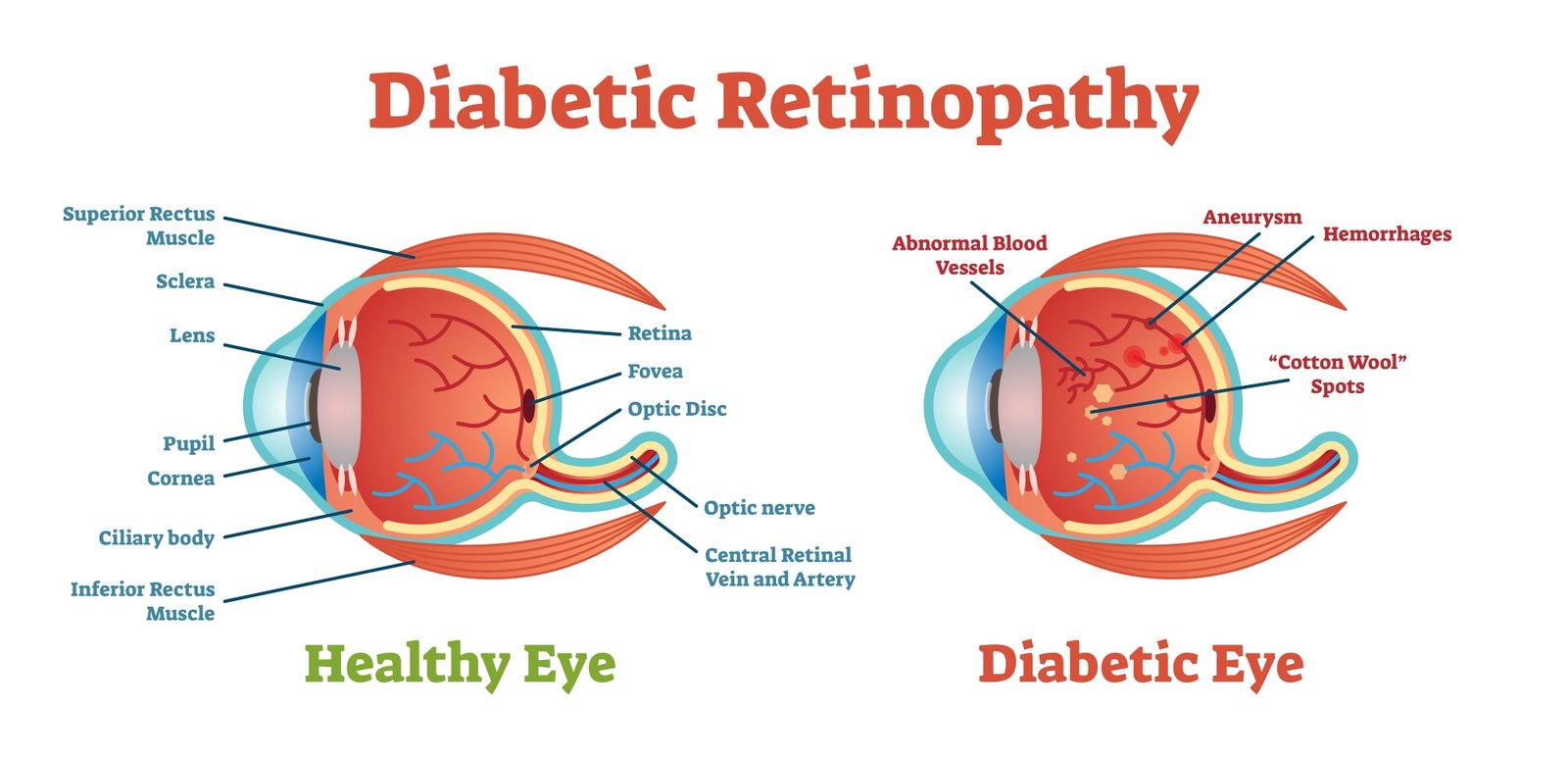
What Is Diabetes-Related Retinopathy?
Think of your retina like a piece of tissue that is constantly working, constantly burning through energy. It is one of the most metabolically demanding parts of your entire body. And it depends completely on a network of tiny blood vessels to keep it fed. Diabetic retinopathy is what happens when diabetes starts wrecking those blood vessels, a complication of diabetes that affects the tiny retinal blood vessels that can cause them to leak, swell, or just shut down. Once that process starts, the cells in the retina begin dying off from the inside. Not dramatically. Not all at once. But steadily.
There are two stages worth knowing about, because where you fall changes everything about your diabetic retinopathy treatment.
First: non-proliferative diabetic retinopathy. This is the earlier stage. Small blood vessels in the retina get weak and start to leak fluid into the tissue around them. And here is the part that trips people up, retinopathy symptoms at this point? Usually nothing. You might get some mild blurring, maybe. Or you might feel completely fine. That is why a dilated eye exam matters so much. It is honestly the only way to catch diabetic retinopathy before it has had time to dig in deeper.
Then there is proliferative diabetic retinopathy, and this is where things get serious. When too many blood vessels have closed off and the retina is starving for oxygen, your body tries to fix the problem on its own. It grows new blood vessels. Sounds helpful, right? It is not. Those new vessels are flimsy, they grow where they should not, and they bleed at the slightest provocation. They can tug on the retina hard enough to detach it. Vision loss at this stage can be sudden, severe, and in some cases there is no getting it back. And the shift between stages — from non-proliferative to the proliferative form of diabetic retinopathy, does not always happen slowly. Sometimes it moves faster than anyone anticipated.
One more thing to understand: diabetic macular edema. This one can appear at any stage of diabetic retinopathy, which is partly what makes it so unpredictable. What happens is fluid collects in the macula, that tiny spot at the center of your retina that you use for everything that requires sharp vision. Reading a menu. Driving. Recognizing your kid’s face across a room. When the macula swells, all of that gets compromised. It is actually one of the biggest reasons people with diabetes deal with significant vision loss, and it can throw a wrench into diabetic retinopathy treatment at any point along the way.
Now, high blood sugar levels cause damage to blood vessels all over the body, your heart, your kidneys, your feet. But retinal blood vessels are in a category of their own because they are impossibly small and impossibly important to your vision. Type 1 diabetes and type 2 diabetes both carry the risk. The longer you have had diabetes, the more likely diabetic retinopathy becomes. But it can also show up earlier than you would expect, which is why regular dilated screening is not something you can afford to skip. If you have diabetes, get your eyes checked. Symptoms or no symptoms. Do not wait for something to feel wrong.
Why Macular Edema and Retinal Damage Go Beyond Sugar Control
This is the part most people with diabetes never hear clearly enough from their care team.
Yes, blood sugar matters. Nobody is disputing that. Keeping your glucose in a decent range absolutely slows down the progression of diabetic retinopathy, and you should keep doing everything your doctor tells you on that front. But here is what catches people off guard, good glucose numbers do not guarantee your diabetic retinopathy stays put. I have watched it happen. Patients who are doing everything right. A1C looks great. Their doctor is happy. And then the next scan shows more damage than the one before.
How? Why?
Because glucose is only one piece of the puzzle. There are other forces at work inside your body that keep pushing diabetic retinopathy forward, and most of them have nothing to do with what your blood sugar read this morning.
Chronic inflammation, for one. It wears down the walls of your blood vessels and makes them leak. Then there is oxidative stress, basically your body producing waste products faster than it can clean them up, and those byproducts chew through the fragile tissue inside the retina. And poor circulation on top of all that, which means the cells in your retina are not getting the oxygen or the nutrients they need to survive. Those three factors feed off each other. They keep diabetic retinopathy moving forward even when your glucose looks fine on paper. Even when you feel like you are doing everything right.
Most diabetes care runs on a pretty standard track. Your endocrinologist watches your glucose. Your ophthalmologist watches your retina and steps in with injections or laser treatment once diabetic retinopathy crosses a certain line. That system does its job, but there is a blind spot in it. Nobody in that lineup is directly targeting the inflammation, the oxidative stress, or the circulation problems that keep diabetic retinopathy going. Acupuncture is what fills that gap.
How Acupuncture Treats Diabetic Retinopathy
Let me get the obvious question out of the way first: no, we are not putting needles anywhere in your eyes. The points we use for diabetic retinopathy treatment sit along the brow bone, the temples, and the orbital rim, that bony edge around your eye socket. Other points on the arms and legs target circulation, metabolic health, and the autonomic nervous system. Diabetic retinopathy does not exist in a vacuum, and neither does our approach to treating it. Because diabetes affects the whole body, diabetic retinopathy treatment through acupuncture has to work on the whole body too.
In Traditional Chinese Medicine, your vision connects to the liver, kidneys, and spleen. I know, if you have never encountered this framework before, it sounds unusual. But ophthalmic acupuncture works through those organ systems to strengthen your vascular health, improve circulation, and restore the energy supply that your eyes depend on. The philosophy lines up surprisingly well with what we know about diabetic retinopathy from a Western health perspective. And the outcomes we see in our clinic back it up.
Patients coming to us for diabetic retinopathy have told us their vision got clearer over weeks and months. Less blurring. The macular swelling eased up. Things just felt more stable, day to day, they could count on their vision more than before. We document everything, track every diabetic retinopathy case, and compare our findings against whatever your eye doctor is seeing at your regular appointments. That kind of tracking matters because diabetic retinopathy does not always move in a straight line, and we want to know exactly how you are responding.
Here is what matters most: this is not an either-or situation with your existing diabetic retinopathy care. Injections, laser treatment, medications, your ongoing diabetes management, acupuncture sits alongside all of it. It handles the pieces your other providers are not set up to reach.
Results and What the Research Shows
People want to know if this actually works. Fair enough. The question comes up in almost every initial diabetic retinopathy consultation, and it should. Here is what the research says.
In 2025, a systematic review came out in Medicine that pulled together 28 clinical trials, we are talking about over 2,800 diabetic retinopathy patients across those trials. What the researchers found was that acupuncture showed real, measurable effectiveness for diabetic retinopathy. Patients had better vision. Macular swelling went down. Side effects were minimal. And the patients who combined acupuncture with their conventional diabetic retinopathy care did better than those using just one approach or the other. That finding kept coming up.
Before that, a separate review of randomized controlled trials had already shown that acupuncture plus standard medication outperformed medication alone when it came to visual acuity in diabetic retinopathy patients.
And another 2025 review, this one in the Journal of Diabetes Research, looked at how acupuncture affects microvascular damage broadly. Their conclusion: acupuncture measurably slows the kind of damage that drives diabetic retinopathy, specifically through its effects on inflammation, circulation, and oxidative stress. For anyone managing diabetic retinopathy, those are exactly the levers that need pulling.
Zoom out for a second. Diabetic retinopathy is a retinal disease affecting millions of people around the world. It is the leading cause of blindness in working-age adults. That has been true for years and it is still true now. Diabetic retinopathy does not pause on its own. It does not reverse. But, and this is the part worth remembering, people who catch diabetic retinopathy early and come at it from multiple directions tend to hold onto their vision far longer than people who rely on one type of treatment alone. Managing glucose, staying on top of your eye exam schedule, and tackling the inflammation and circulation issues underneath, that combination makes a real difference.
Our diabetic retinopathy patients at Honor Wellness come from all over the map in terms of where they are with the condition. Some have type 1 diabetes. Some have type 2 diabetes. Some found out about their diabetic retinopathy before any symptoms even started, just a scan that showed something was off. Others are further along, already dealing with vision loss, and the goal becomes protecting what is left. We see people who are getting injections for diabetic retinopathy and want another layer of support. We also see people whose diabetes has not caused visible damage yet, but who know what diabetic retinopathy can do and would rather get ahead of it than wait around.
Every plan we put together is specific to whoever is sitting across from us. Your type of diabetes, where your diabetic retinopathy stands right now, what your vision is like today, what you are trying to hold onto, all of it factors in. We stay in touch with your diabetes care team and your eye doctor because none of this works if people are pulling in different directions. Everything you are doing to manage your diabetic retinopathy should be coordinated.
And look, diabetic retinopathy does not warn you before it takes another blood vessel. There is no pain. No flicker. No signal. That is what makes diabetic retinopathy so treatable in theory and so devastating when people wait too long. By the time you notice something wrong with your vision, diabetic retinopathy has usually been doing its thing for months. Sometimes years.
Catching diabetic retinopathy early means looking for it deliberately. A proper dilated eye exam, on a schedule, no excuses. Nobody catches diabetic retinopathy by accident.
Waiting is not neutral. Diabetic retinopathy is the number one reason people with diabetes lose their sight. Vision loss from diabetic retinopathy can be severe and permanent. But diabetic retinopathy is also treatable, particularly when you start early and hit it from every angle available to you. Your diabetes management covers the glucose. Your eye doctor covers the monitoring and the procedures. Acupuncture covers the inflammation, the circulation breakdown, and the oxidative stress that nobody else on your care team is equipped to go after directly. That three-pronged approach gives you the strongest shot at keeping your vision intact.
If you have diabetes and your vision is on your mind, or if diabetic retinopathy is already part of your reality and you are tired of just watching and waiting, reach out to Honor Wellness for a consultation. Diabetic retinopathy does not get to write the ending here. The sooner you treat diabetic retinopathy from every angle, the better your chances of holding onto the sight you still have.
Frequently Asked Questions
What are the primary triggers that cause diabetic retinopathy to develop?
The primary trigger that causes diabetic retinopathy to develop is persistently elevated blood sugar levels that damage the tiny blood vessels supplying the retina over time. High blood pressure, high cholesterol, long duration of diabetes, smoking, and poor overall glycemic control all significantly accelerate the onset and progression of retinal damage. Pregnancy can also trigger or worsen diabetic retinopathy in women with existing diabetes. Managing blood sugar levels consistently, maintaining a healthy lifestyle, and supporting retinal circulation through regular acupuncture treatments are all important steps in reducing the risk of developing this sight threatening condition.
Does every person diagnosed with diabetes eventually develop retinopathy?
Not every person diagnosed with diabetes will develop retinopathy, but the risk increases significantly with the duration of the condition and the consistency of blood sugar management. Research indicates that a large proportion of people who have lived with diabetes for twenty years or more will show some degree of retinal changes. Those who maintain tight glycemic control, manage blood pressure and cholesterol effectively, attend regular eye screenings, and support their overall health through lifestyle and complementary therapies such as acupuncture significantly reduce their risk of developing vision threatening diabetic retinopathy.
What are the four recognized stages of diabetic retinopathy progression?
The four recognized stages of diabetic retinopathy progression begin with mild nonproliferative retinopathy, where small areas of swelling called microaneurysms first appear in the blood vessels of the retina. The second stage is moderate nonproliferative retinopathy, where blood vessels begin to swell and lose their ability to transport blood effectively. The third stage is severe nonproliferative retinopathy, where a larger area of blood vessels becomes blocked, depriving the retina of adequate blood supply. The fourth and most advanced stage is proliferative diabetic retinopathy, where fragile new abnormal blood vessels grow on the surface of the retina and can leak, bleed, and cause serious and potentially irreversible vision loss.
At what A1C level does the risk of diabetic eye complications become significant?
The risk of diabetic eye complications becomes significant when A1C levels consistently exceed 7 percent, which corresponds to an average blood sugar level that begins to cause cumulative damage to the small blood vessels of the retina over time. The higher the A1C and the longer it remains elevated, the greater the risk and severity of retinal damage. Most diabetes care guidelines recommend maintaining an A1C below 7 percent to minimize the risk of microvascular complications including diabetic retinopathy. Regular eye examinations, consistent blood sugar monitoring, and complementary support through acupuncture to improve circulation and reduce systemic inflammation are all essential components of protecting long term eye health.